Cobblestones, Stairs and Sudden Rain: Which Suitcase Wheels Survive a Real British Journey?
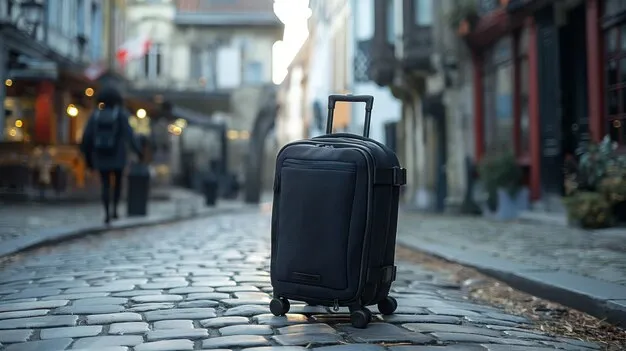
Photo: suitcase wheels cobblestone street pulling luggage, via img.freepik.com
Every luggage brand video shows the same fantasy: a suitcase gliding effortlessly across a polished marble floor. Lovely. Now try hauling that same case up the steps at Borough Market, across a rain-slicked platform at Crewe, or over the cobbles of a Saturday-morning farmers' market town.
That's the gap between marketing and Britain. So we took two comparable medium cases — one four-wheel spinner, one classic two-wheel roller — and put them through a day of genuinely British surfaces. Here's what happened.
Round One: The Cobblestone Test
Cobbled high streets are the spinner's natural enemy. The four small wheels, each pivoting independently, catch on every uneven stone. The result is a rattling, bucking ride that transmits every bump straight up your arm, and a case that wants to tip onto its side when you turn too quickly.
The roller, with its two larger set-in wheels, simply rolled over the cobbles like a slightly grumpy sledge. It needed tilting onto two wheels — which is its whole design philosophy — and once tilted, it handled the bumps far better. Our arms knew about it afterwards, but the case never stalled or snagged.
Winner: two-wheel roller, comfortably.
Round Two: Tube Stairs and Train Gaps
London Underground stations are essentially a luggage obstacle course: long corridors, sudden flights of stairs, gaps between train and platform wide enough to eat a small wheel.
Here the spinner's party trick shines. Stand it upright, give it a nudge, and it walks beside you hands-free down a wide corridor — genuinely useful when you're also holding a coffee and a phone ticket. But at the first staircase, the advantage evaporates. Four small wheels offer no grip for stair-climbing, and you end up carrying the full weight anyway.
The roller's bigger wheels and rear frame make stairs marginally less awful — you can bump it up step-by-step rather than dead-lifting it. Neither case makes the Victoria line a pleasure. The roller just makes it less of a workout.
Winner: draw, with a slight edge to the roller.
Round Three: Wet Platforms and Paved Forecourts
Smooth, wet, flat surfaces — a rain-soaked platform, an airport forecourt — are where spinners are unbeatable. Full 360-degree movement, zero lifting, and the ability to park the case sideways in a crowded carriage. On anything flat and hard, the spinner is simply the more pleasant object to travel with.
Winner: four-wheel spinner, and it's not close.
So Which Should You Buy?
Match the wheel to the journey:
- Older holidaymakers or anyone with back or shoulder concerns: a spinner, but a quality one with larger wheels (look for 60mm or more) and a sturdy frame. The lifting-free glide through airports matters more than the occasional cobbled wobble — just take the taxi from the station.
- Frequent flyers and commuters: a spinner again. Your journey is 90% smooth floors, and hands-free manoeuvrability through terminals and carriages is worth real money in comfort terms.
- Families with heavy loads: a two-wheel roller, or a large hybrid. Big wheels, a low centre of gravity and a case that stays stable when overpacked are exactly what you want when you're also towing a buggy and a toddler across a cobbled seafront.
- Cottage holidays, festival trips, market towns: roller, every time. Rural Britain was not paved with spinner wheels in mind.
The Verdict
There's no universal answer — only the right answer for your route. Spinners own the airport; rollers own the high street. If your travels start and end at big terminals, go four-wheel. If they begin with a cobbled car park and a walk to a self-catering cottage, the old-fashioned roller is quietly still the best engineering for the job.
Check the wheels before you check the price. They're the only part of the suitcase that actually touches the ground — and in Britain, the ground fights back.